

What problems do we treat
- Herniated disc
- Scoliosis, poor posture
- Other diseases associated with neck, back, and lower back pain
- Postural disorders in adults and children
- Preventive advice in childhood and for sedentary occupations
- Long-term muscle pain
- Osteoporosis
- Post-treatment of neurological conditions (Stroke, spinal cord injury)
- Degenerative joint diseases
- Other rheumatological diseases (RA, SPA)
- Post-surgical rehabilitation (spine, hip, knee, ankle, shoulder, elbow, wrist)
- Rehabilitation after accidents and sports injuries
What methods do we use to treat
- Evminov spinal therapy method
- Manual therapy
- FDM Therapy
- McKenzie method
- Kinesiotaping
- Trigger Point Therapy
- Cupping therapy
- Bobath method
Evminov therapy
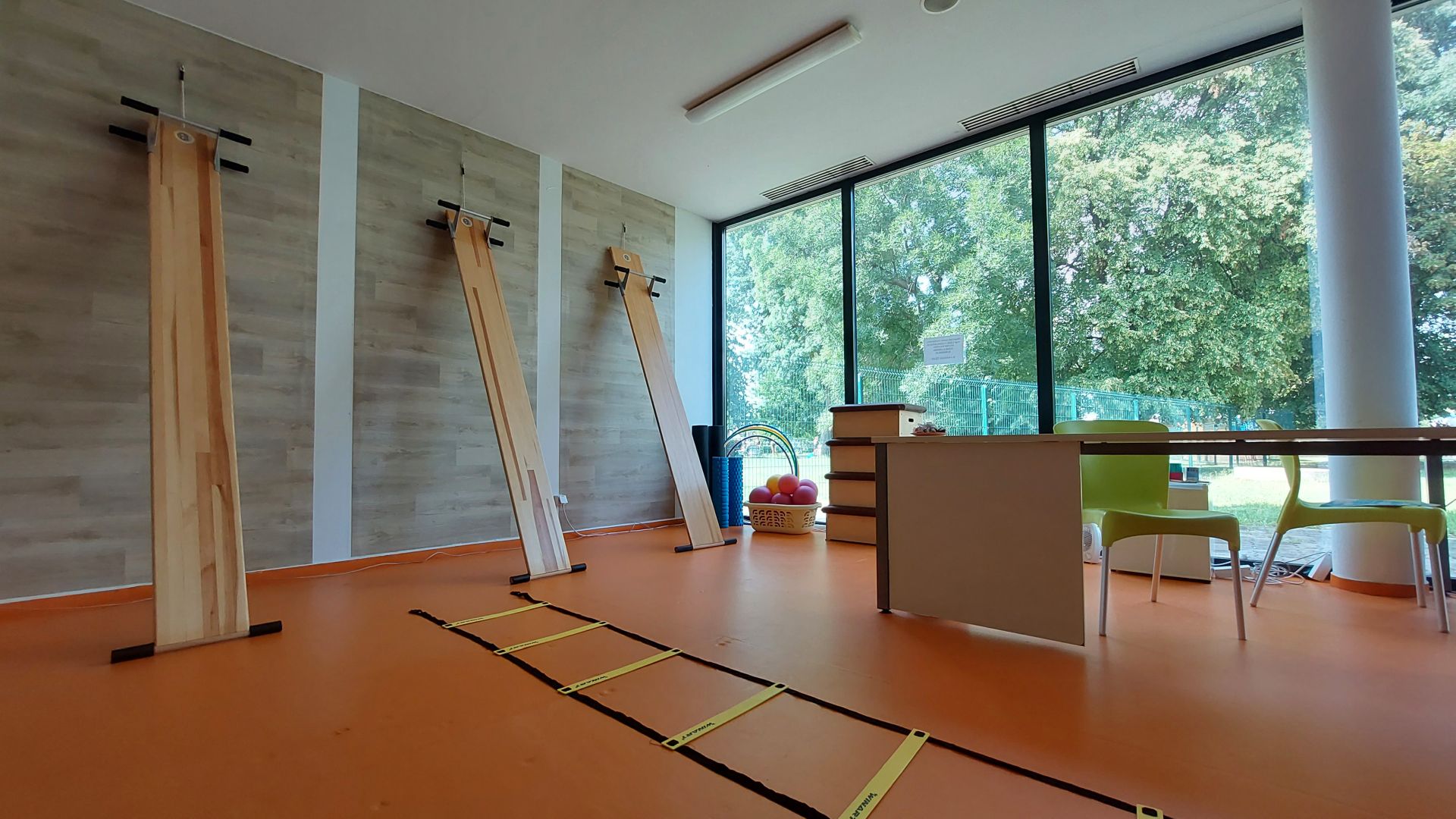
Evminov prophylactor
A uniquely developed and patented medical aid, which has 46 pieces made of specially prepared and dried, knot-free wood, using a manufacturing technology similar to that of skis. This technology allows the bench to have the proper flexibility during gymnastics. The Evminov prophylactor has a static load capacity of 600 kg and a dynamic load capacity of 140 kg.
A traditional, homemade board cannot replicate this, in fact, it can even be dangerous for your health! Performing a similar movement on a hard surface can further worsen existing spinal problems and may even cause injury during use!
The bench is an extremely simple, yet unique tool for the treatment of spinal problems.
What makes it so great?
With regular use, significant improvement can be achieved in a relatively short time for almost any spinal issue, whether it is a simple poor posture, scoliosis, or even a herniated disc, which can also be effectively treated with its help.
Who do we recommend using the Evminov profector for?
In the case of a herniated disc
In the 21st century, herniated discs, commonly known as slipped discs, have become widespread ailments and can be accompanied by very painful symptoms. The symptoms can range widely from numbness to unbearable pain. (Paralysis may even occur.) In the long term, the pain can lead to severe mobility restrictions. The effectiveness of Evminov therapy in cases of herniated discs has been confirmed by clinical studies.
Before surgery, it is definitely worth treating the problem with special stretching and strengthening exercises performed on the Evminov profiler, thereby greatly increasing the chances of avoiding surgery.
For neck, back, and waist pain
Persistent pain indicates that certain degenerative processes have already begun in the spine. To reduce pain and stop the process, it is definitely worth performing Evminov spine exercises 2-3 times a week for preventive purposes.
For office and sedentary workers – for preventive purposes
If you carry out office or other sedentary work for even 8-10 or more hours a day, your spine is subjected to a very high load, which can cause irreversible damage to the small joints of the spine and the intervertebral discs.
For children
According to surveys, 80 percent of primary and secondary school students struggle with posture defects and associated pain. The cause lies in a sedentary lifestyle and prolonged periods of sitting. Our children spend a lot of time slouched in front of various smartphones, tablets, and laptops. As a result, poor posture, scoliosis, and disc degeneration often develop.
Evminov therapy is excellently suited to prevent and reverse these processes, and thus raise our children for a healthier life.
Athletes
For active athletes and competitive athletes, it is common that sports activities place asymmetric strain on the body, which can lead to various problems and pains in the short or long term.
It is definitely worthwhile for athletes to regularly practice Evminov exercises, as this can help reduce the extent of muscle imbalance that develops in the body, which can later be a source of a lot of pain.
Physical Therapy
Physical therapy is the physiotherapeutic method through which musculoskeletal complaints and certain injuries can be treated most effectively in the long term. At the Medical Center, our qualified physical therapists provide personalized movement therapy. The goal of physical therapy treatment is to reduce pain, improve and restore joint mobility. During the treatments, patients learn what they can do to reduce or eliminate their complaints.
Indications for physical therapy:
- Degenerative joint diseases
- Osteoporosis
- herniated disc
- Spine problems associated with neck, back, and lower back pain
- Postural defects / poor posture, scoliosis /
- Postoperative care and rehabilitation
- Post-accident and sports injury care
Water gymnastics
The effectiveness of water therapy lies in combining the positive effects of the thermal water of Pápa and exercise. Due to the buoyancy of water, during water gymnastics our body feels like it loses nearly 90 percent of our weight, which allows us to perform exercises that are difficult to do in traditional land-based workouts. Physically, the resistance of water is about 12-14 percent greater than that of air, so training in water can challenge our muscles as much as, or even more than, exercises performed on land.
Benefits:
- Joint-friendly
- No swimming skills required
- Enhances blood circulation
- Positively affects the respiratory system
- Develops the muscular system
- Refreshing, invigorating, stress-relieving effect
- Contains an easily learnable, effective workout suitable for all age groups
Who we recommend it for:
- in case of neck, waist, and back pain
- for the purpose of posture improvement
- in case of degenerative joint disease
- in case of osteoporosis
- general strengthening of a weakened body
- rehabilitation after orthopedic and trauma surgeries
McKenzie Therapy
The McKenzie method is a special movement therapy that is one of the most effective treatments for certain spinal problems. The treatment is always preceded by a thorough assessment of the condition and movement testing. Based on this, the physiotherapist decides what movements are needed to improve the condition. The McKenzie method is an active movement therapy in which the patient independently performs the exercises compiled by the physiotherapist several times a day.
Who we recommend it for:
- spinal problems of mechanical origin
- lumbago
- sciatica
- neck, back, and lower back pain
Manual therapy
Manual therapy is a specialized diagnostic and therapeutic procedure that deals with the natural treatment of acute and chronic musculoskeletal disorders. Each treatment is preceded by a comprehensive, detailed patient examination.
Due to an unhealthy lifestyle / prolonged sitting, overstrain from sports activities or work /
certain muscles become shortened and spastic, while others become overstretched, which over time leads to pain and restricted movement. This affects not only the location of the problem but also joints and soft tissues farther away.
Manual therapy treats the root cause of the pain. The therapist uses mobilization techniques to release stiff, restricted muscles, addresses dysfunctions of the pelvis, spine, and joints, thereby improving function and reducing pain in a lasting way. The patient always receives an individualized set of exercises to ensure that the results achieved in therapy are long-lasting.
Many people mistakenly confuse manual therapy with chiropractic.
Manual therapy can only be performed by a doctor or physiotherapist with a degree.
In which cases we recommend it:
- acute and chronic neck – back – lower back pain
- herniated disc
- limb numbness
- pinched nerve
- large joint pain (hip, knee, ankle, shoulder)
- small joint pain
- golfer's elbow, tennis elbow
- musculoskeletal-origin headaches
- pain caused by scoliosis
Trigger Point Therapy
Trigger points and tender points are palpable sensitive knots in muscle tissue that can cause local and radiating / symptoms far from the painful muscle knot.
They are naturally not visible from the outside; the therapist feels them in the muscle.
Tender points only cause local pain in the muscle, while trigger points can induce radiating complaints in a distant part of the body.
For example, the true cause of severe head and neck pain is often a trigger point located in the thoracic region.
The characteristic of trigger points is that they can mimic many types of complaints / lower back pain, headache, lower limb radiating symptoms, shoulder pain /.
During trigger point therapy, the practitioner thoroughly examines the patient's muscles, and after palpating the trigger point, applies even pressure to release it. Afterward, the patient is given targeted muscle strengthening and stretching exercises to ensure that the effects of the therapy are long-lasting.
When do we apply it?
- tense, overloaded, adhered muscles
- muscle balance disruption
- radiating pain
- muscle balance disruption
Bobath Therapy
The Bobath method is a treatment procedure used in movement disorders caused by brain damage (e.g., in the case of a stroke).
Depending on the clinical symptoms and the extent of the damage, the goal of the treatment is to teach and develop postural and movement functions.
Who we recommend it for
- after a brain event
Kinesiology tape 'Kinesiotape'
It can be used as a complementary therapy for musculoskeletal complaints. Its areas of application are extensive. Depending on the method of application, it can be used for muscle relaxation, muscle activation, reducing swelling, edema, bruising, pain relief, and increasing reduced range of motion.
FDM Therapy
In the FDM is an acronym, Fascia Distortion Model. A revolutionary new treatment method with which many musculoskeletal problems can be treated and reduced very quickly and effectively.
Tahnks to the fascia term medically refers to a connective tissue sheath or layer that permeates our entire body. It surrounds muscles, nerves, lymphatic and blood vessels, internal organs. From the FDM perspective, this includes tendons, ligaments, and the joint capsule that surrounds the joints.
Tahnks to the Distortion refers to a structural and/or functional alteration of this connective tissue sheath or layer, which may manifest as pain, restricted movement, numbness, or swelling.
Tahnks to the Model's creator, Dr. Stephen Typaldos, noticed that his patients, regardless of which part of the world they came from, always pointed to the exact location of the pain with their hands and almost always indicated various complaints based on the same pattern.
The FDM therapist uses this 'universal language of pain' to select the appropriate treatment technique for treating and healing the given painful area.
In many cases, the treatment is not exactly painless, but even a single session can achieve a state of being pain-free.
Who we recommend it for
- in case of chronic musculoskeletal complaints
- in case of acute musculoskeletal complaints
Cupping
Cupping is one of the methods of traditional Chinese medicine. Its healing effect is exerted by the vacuum created.
Positive effects:
- muscle relaxation
- improves muscle elasticity
- improves local circulation
- can help release adhesions of scars
- can help improve restricted joint movements
With the help of Magdolna Nagy, physiotherapist.
Registration: 06 89 512 616
 Magyar
  Slovenčina
  English
  Deutsch
  Čeština